
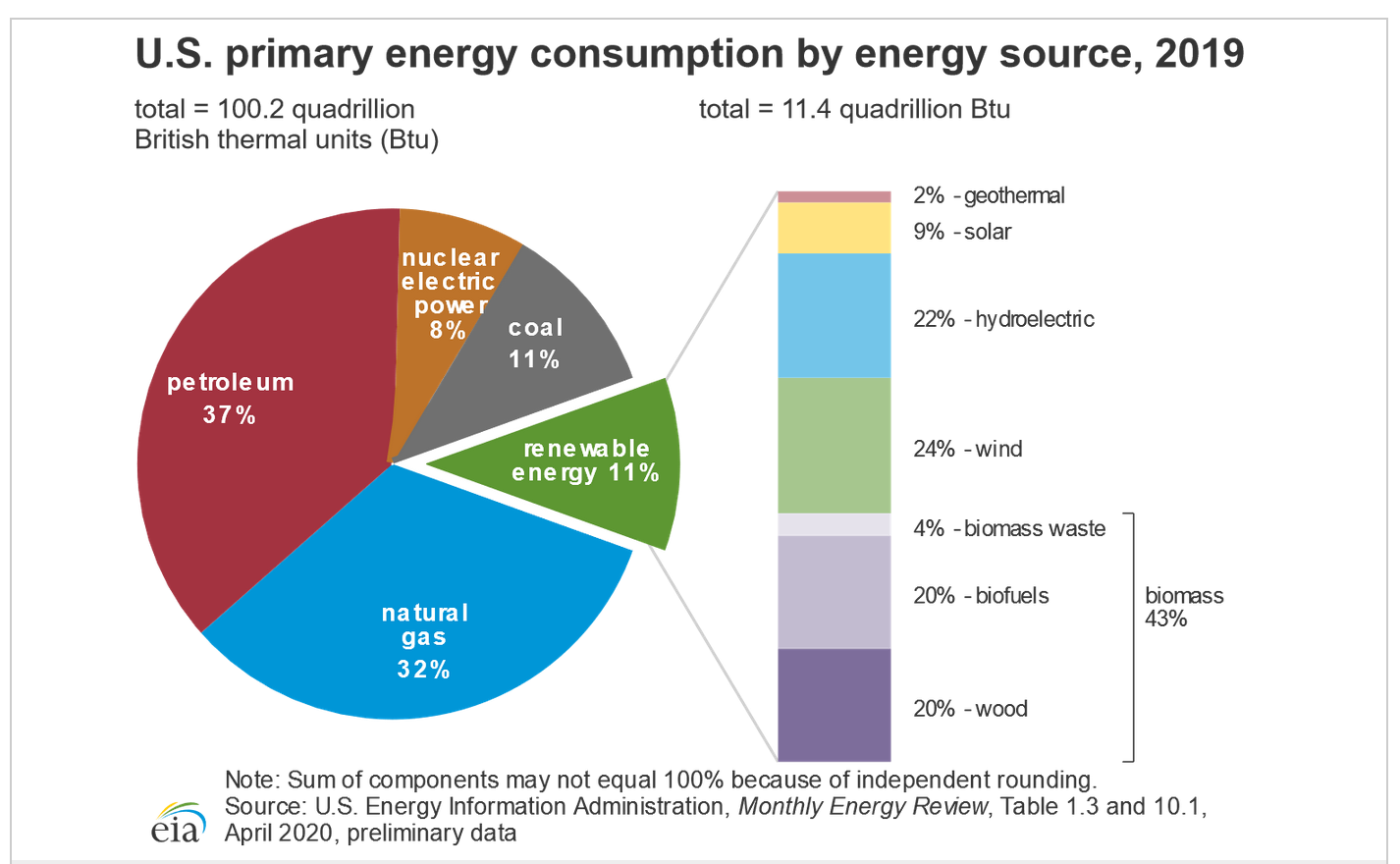
 The problem with charging BEVs is that only a small percentage of cars can be charged using only 100% clean and green renewable sources. Most of the electrons going into a BEV are coming from the grid, which is 60% powered by fossil-based power generation in the US. As more BEVs are sold, the need for charging them puts more demand on energy supply, and further strains on the power grid. Taken individually, this hardly seems to be a note for concern. But add up all the BEVs on the road now and factor in future sales, and the increase in power consumption demand becomes staggering.
A BEV like the Tesla Model 3 requires 82 Kwhs to charge. The breakdown on charging times looks like this: One Tesla battery requires a 15 KW power source charging for 5.5 hours, or a 30 KW system charging for 2.75 hours, or a 60 KW system charging for 1.37 hours, or 120 KW system charging for 40 mins. We consider the 120 KW system at ideal conditions at hypothetical 100% efficiency for fast charging times. Since the US grid is backed by 60% fossil fuel - finding a clean and green electron in the mix is next to impossible. Burning one ton of coal produces 5,720 lbs of CO2 and one pound of coal produces 1 kWh (1.13 lb actual) and 2.86 lbs of CO2 - it would take 82 lbs of coal burned AND 234.5 lbs of CO2 emitted to charge a Tesla battery to 100%. Since the average American drives 13,500 miles per year - the Tesla uses .27 kwhs per mile - that equates to 3,645 kwhs per year. Therefore a Tesla driving an average mileage per year will generate 10,424.7 lbs (5.2 tons) of CO2 per year using electrons from a grid backed charging point. The average ICE car produces 4.5 metric tons per year at the same 13,500 mile average - 9,900 lbs - (500 lb less than the Zero Emissions Tesla being charged over the grid).
According to the DOT - there are 250,000,000 vehicles registered on the roadways of America. Further - according to the DOE - the US presently consumes 3.8 terawatt hours annually. If we multiply the amount of EVs registered in America - just over 2,000,000 and multiply the 120 KW supply to charge (a Tesla in 40 minutes) total EVs (and hybrid) and we would need an additional 240 Gigawatts of power with a 40 min fast full-charge battery.
But this power number actually doubles due to charging limitations of the Tesla battery technology. It is recommended by Tesla "to charge to 90%" for daily driving and 100% for long distance driving and to charge back up at 50%. That basically means for daily driving you battery capacity (mileage range) is only good for repeated use at 40% capacity OR your battery life will be dramatically shortened. The other now well known fact is the Tesla battery energy starts to rapidly discharge at over 60 mph. Therefore - if you're like most drivers at 70-75 mph - your battery range will be dramatically shortened by normal driving. And then your stuck in Charging Lines waiting for an available Super Charger. Considering this exteme energy draw post 60 mph - the actual mileage of the Tesla becomes substantially reduced. Therefore - the more charging is required and the .27 kwhs per mile becomes exteme and the CO2 emissions to charge a Tesla increase eponentially beyond 5.2 tons of CO2 per year.
Considering we need 82 square miles per RE energy (50% solar/50% wind) for each 1 GW base load energy displacement to satisfy this emerging power-need while also considering the capacity factor of both solar and wind - (20% and 42% ). The US would need to set aside 19,680 square miles of additional territory that would be consumed by ONLY 2,000,000 EVs needing charging supply. The main requirement jumps 20,000 square miles every 2,000,000 vehicles that become electrified. Considering only 10% of the existing 250,000,000 vehicles on the road in the US (25,000,000 vehicles) and convert them to electric would equate to 240,000 square miles of land mass to build out wind and solar farms, i.e. almost double the entire land mass of California! IF all cars and trucks were electrified at a 1:1 ratio equivalent to a Tesla Model 3 battery of 82 kWhs and charged up by 100% RE clean and green electrons - the US would be completely inundated with wind and solar farms stretching from California to New York totaling 2.4 million square miles.
 The US as well as 30 countries have mandated a "phase out" of new gasoline cars sales by 2040 and must include the sales of BEV, HFCV, and other zero emission cars (ZEVs). The eventual aim is to eliminate ICE vehicles altogether. Where will these additional multi-TWhs come from to charge up 10s of millions of new cars coming to market in the US?
More people means more power consumption
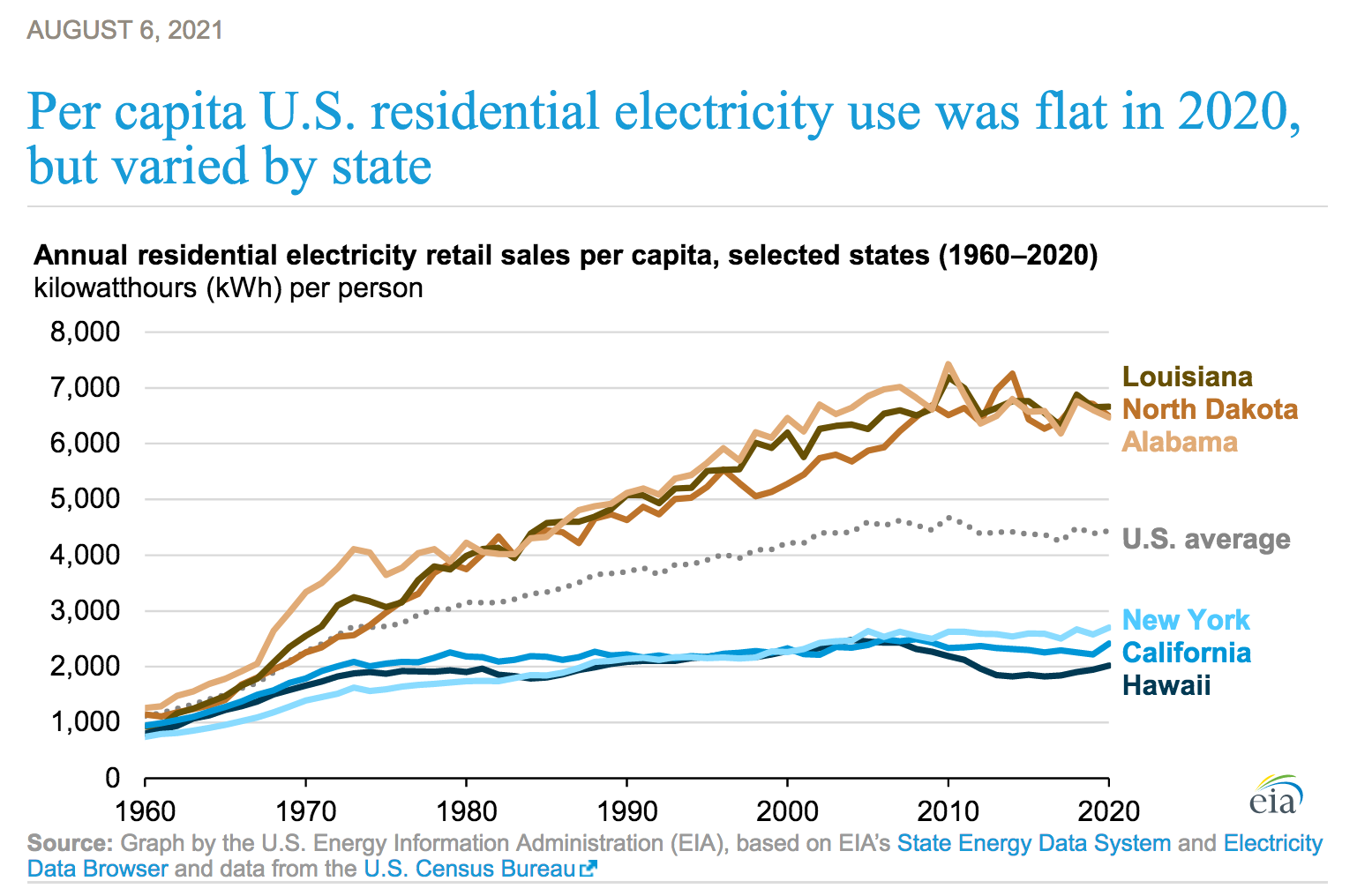
The US Consensus Department predicts a population increase of 79 million by 2060. Accordingly the power consumption per capita in the US stands at 4,487 kWhs. If we only consider the increased electrical energy demand per increase in population by 2060 - the US will need to contribute an additional 354 TWhs. A 1 GW power plant operating at 100% of the year (make the math simple) will generate 8.76 TWhs per year. With just the increase in population we need to build 40 new 1GW power plants. This is considering fossil based power plants that can operate 24/7/365. If we look at the capacity factor of solar and wind - that TWh nameplate capacity figure jumps 100 fold.
 Shot from Apollo 7 FloridaThe extraterrestrial solar radiation of the sun is 1367 watts per square meter (the value when the Earth–Sun distance is 1 astronomical unit), then the direct sunlight at Earth's surface when the Sun is at the zenith is about 1050 W/m2, but the total amount (direct and indirect from the atmosphere) hitting the ground is around 1120 W/m2 - 42 to 43 percent visible (400-700 nm), and 3 to 5 percent ultraviolet (below 400 nm). (wikipedia) Since solar panels only use the smaller portion of visible light spectrum in the red and violet range - most of the sun hitting the earth cannot be used for photovoltaic solar generation. Of the 1120 W/m2 only 448 W/m2 can be converted to solar power. Since there is 3.797million square miles of surface area in the US - total potential solar energy from the sun considering a 20% capacity factor - 4.8 hours average per day of the year - (convert M2 to m2 = 9.8 trillion square meters X 448 W/m2 = 4.3 petawatts. Since the US government only owns 640 million acres of the total of 2.27 billion acres as the US total acreage - trying to crunch 4.3 petawatts of solar power into 2.27 billion acres would eat up 100% of the remaining free space in the US. And that is without considering the size of the solar hardware per panel.
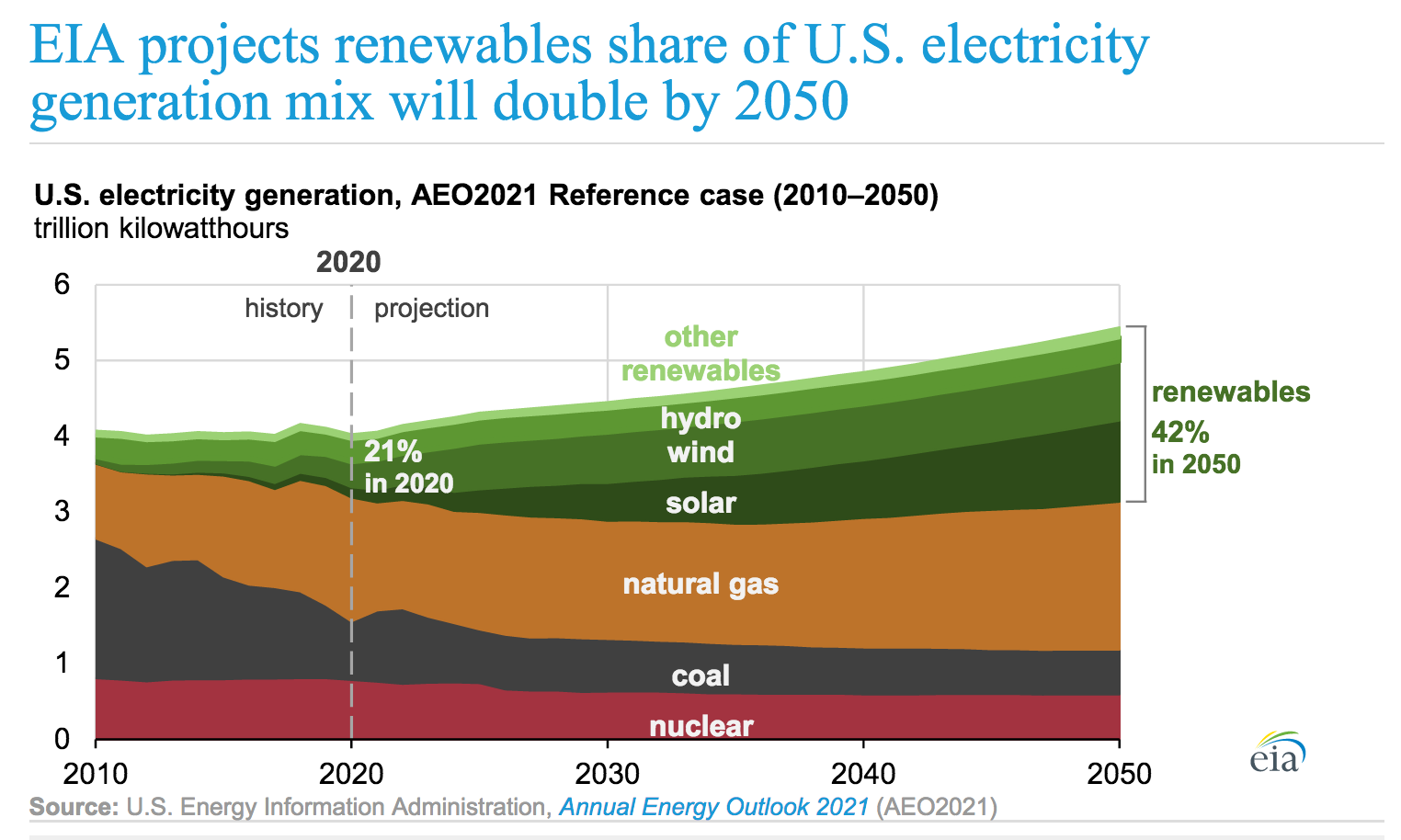 According to the EIA the US energy consumption will reach 5.5 trillion kilowatt hours - 5,500 Twhs by 2050. This info graphic shows a projected 42% share of the national total by 2050, i.e. 5,500 X .40 = 2,200 Twhs if RE. We established each 1 GW power plant generates 8.76 Twhs per year (hypothetical 100% operational during the year). To fill that 42% gap - we need to build the equivalent of 627 - 1 GW plant equivalents. Considering 50% solar and 50% wind - that land mass would equate to 52,000 square miles consumed.
Rethinking the filling station
First, let us rethink what a filling station is, or was, depending on when you read this. Typically a vehicle pulls into a filling station, and "fills up" with a variety of liquid fuel choices, and drives away with a tank full of gas and snacks for the road. We all know the model, but what if we changed the "Filling Station" recipe to included localized power production using 100% clean-burning hydrogen? This will completely remove the need to power all these BEVs from the grid, which is about 60% fossil-based, and under increasing strain. BEV owners can rest assured that the electrons filling their car is produced on-the-spot with the cleanest burning fuel on the planet. Further, on-site power-generation enables the entire station to go off grid. Need more power as business expands? No problem. Just add another hydrogen-power generator. Generating electrons from hydrogen on the spot can do a number of things including:
- On site BEV charging using ONLY 100% clean and green electrons
- Modular systems equate to easy-growth
- Grid independence -- forget about copper lines altogether
- Escape from rolling blackouts
- Become a major solution to growing climate change
Full suite of fuel
Increase fuel offerings by integrating our hydrogen based bridge fuels or Hy-fuels along with traditional gas and diesel. Element One Technologies Hy-fuels offer instant and significant reductions in green house gasses, pollution and carbon emissions. No matter what customers are driving, the new fuel-stations can deliver. From hydrogen and clean-charging for BEVs, to Hy-fuels to traditional and multi-octane gas and diesel, if it moves - it can be re-charged/filled with these grid-independent filling stations.